

Tell us about the show you’re currently workshopping, Clown Fish Out of Water?
‘Tis my 3rd Edinburgh show. This year the premise is more about feeling like a pariah as a highly creative, genre-bending act in the entertainment industry, alongside the usual absurd series of set pieces and also how, as an autistic man, I do not feel I fit in society in general.
All the sketches and routines are true (from a certain point of view), though some of the events I talk about – like performing in a sex dungeon – definitely happened in our reality and not just in Stephen’s universe.
How does this show build on the themes you’ve explored in your previous cult hit shows?
Clown Fish Out Of Water is a semi-sequel to last year’s show, Moving On… Really Really Slowly, in that I do talk about the tragic loss of my slug mask, which was vital to the show. But spiritually, it is more an expansion on Beehavioural Problems. The narrative target has shifted from standard employment struggles to deep isolation within corporate society. It’s not a family show.
The show is evolving a new tone. While I still use my masks, this is a deeper dive into autism and neurodivergent unmasking. Previous shows have been more clowny. This show, unlike previous, is more Hicksian ideologically due to a sense of feeling cut of from the mainstream. Just as Hicks hated the commercialism of rock, I do not love the commercialism of comedy, especially at the Fringe which has also been a sacred playground for acts to really push the boundaries.
It is also getting more focused on reality directly, as I am not hiding behind the metaphorical or literal masks as much, which is why I am a Clown Fish Out Of Water – I am a fish and cannot breathe air, I am a clown I cannot breathe water.
Some would say the absurdism is heightened with certain bits, and the new opening is perhaps my most risky entrance I have ever written and performed.
You’re known for your surreal and absurdist use of props, and this show is no different. What about an object inspires you to incorporate it into a show?
The formulae of my prop work often works the other way round. I come up with the idea, then get the prop, and then try and fail a couple of experiments before it starts speaking to me like the Green Goblin mask in Sam Raimi’s Spider Man and reveals the right path.
There are instances like the Church of Dog that the mask came first (granted I got it with the intention of using it to be a were-pug) and then the ideas emerge, but for the most part idea then prop then experiment then recalibration and/or refining.
The slug for Moving On was a mixed example because on the one hand I wanted to make a show about heartbreak, and a slug was a natural fitting animal. But in contrast, I wanted to do a show where I started as a slug because it was funny and it married well to the premise of the show I wanted to make.
But generally the physical form of the object triggers an unexpected cognitive link, which then pushes me to a highly logical—yet completely preposterous—conclusion. For all the chaos and madness that people think, I fundamentally function under a reductio ad absurdum framework.
This show tackles issues within the entertainment industry head on. How do you balance the importance of that message with the surreal light-heartedness your style of performance is known for?
The props, the clowning and the music that I use are how I do this. This show without these would just fundamentally just be a comedic rant on the faults of the industry.
By doing things like daubing people with shaving foam or making a lettuce do burlesque, the underlying anger becomes unhinged and joyful with my manic glee. The presentation allows me to present the anger in a way that is palatable and gets my message across, but maintains a spirit of fun that I always ensure my shows have. The contrast of my anger being presented as unhinged chaos and joy become the mechanism of delivery. The more celebratory and unhinged things get and entertaining for the audience, the more I am sticking my middle finger at the man.
I have never felt comfortable preaching to people my views. By being light, it allows us to get to my point. I am not my audience’s enemy. They are my allies with whom I can commit to my rebellion. I am basically just a few steps away from handing somone a molotov cocktail and saying “hey comrade let’s tear these motherfucking walls down” with a knowing wink.
What do you hope people take away from this show?
Barring a deeper understanding of autism and the difficulty of fighting the ingrained cognitive bias of it? My deepest desire is that people will actually seek the original and commercialise that which takes risks and pushes boundaries. There is nothing wrong with the vanilla and safe TikTok acts (and hats off to them for capitalising on that bandwagon), but there must be room for the rest so we do not stagnate as a species.
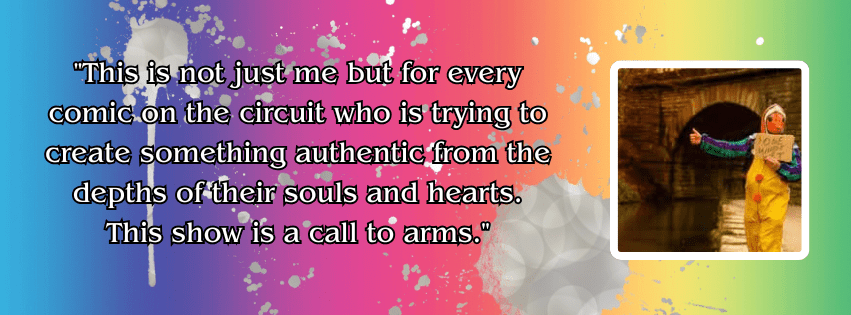
However if we keep going down the path we going, fewer and fewer people will be able to do inventive and creative work, which in turn results in just more of the same. This will extend to other areas in politics and society will stagnate. When it does that, it will not adapt to change and begin to rot and wither away, and the world just becomes a whole lot shittier. So I hope they understand that to stop that will help us. This is not just me but for every comic on the circuit who is trying to create something authentic from the depths of their souls and hearts.
This show is a call to arms.
How has the show been received so far?
I have received a 4 star review from Everything Theatre for my London Preview at Etcetera Theatre. The Buxton Fringe reviewer commented “It’s been a while since I’ve seen something quite that surreal”. So that’s good.
I’ve been working with Phil Green (my director and a comedian I recommend people check out at fringe as well – Phil Green: The Boy Who Nearly Grew Up (WIP)) and Ingenious Fools Ltd who have assured me the work is good. I feel even more excited about the show than last year, I think this is because the themes of the show are not as deeply painful.
What are your hopes for the show going forward?
I really just want some 5 star and 4 star reviews, but I want a lot; one or two is insufficient. I want at least 6 to 8 people to go 4 to 5. I also want the Malcom Hardee award.
I want either the alumni or londonclownfest at Soho Theatre to take it on as well. It’s the recognition I want. It’s all I ever wanted.
Ultimately while previous shows have been marked as victories, Beehavioural Problems was an unexpected victory, while Moving On felt pyrrhic. I want an absolute undeniable victory and the recognition I have always deeply hungered for.
Do you have any advice for other people hoping to create their own show?
My main advice is to do extensive research on the fringe, do as many previews and festivals for the fringe as you can. Gig as much as you can. In the year you wish to debut at fringe, make sure you have stuff to put on the poster (this includes a great image, awards, nominations, stars, quotes, finals) 1) to have that official stamp of quality and 2) to maximize the chance of getting the best venue and timeslot for your work.
Ultimately you need to train hard to fight easy. The fringe can be uncompromisingly brutal and it has no mercy for acts that are under and unprepared. So take risks in the safe places before you go to the dangerous places. Fortune favours the bold, but it abandons the unprepared.
Stephen is currntly touring Clown Fish Out Of Water. You can find out when he’s performing near you by following him on Facebook and Instagram.
