

Tell us about you/your act.
I suppose a lot of my comedy talks about blindness. I am blind, by the way, so I’m drawing on personal experience, as opposed to blindness just being a random topic that I’ve chosen to pursue. I have plenty of comedy that’s not blind-related, but a lot of the weird events and dramas that occur in my life wouldn’t happen if I could see. That’s what my comedy often explores: ordinary events that turn into unusual episodes because I’m blind.
I also play the accordion, because I’m a brazen crowd-pleaser.
How did you get into comedy?
I’ve been in a folk band since 2005, and a big part of folk — certainly in the folk club where we started out — is storytelling. A lot of that storytelling and chat between the songs is funny. We grew up seeing that in the folk clubs, so it was natural that we’d incorporate it ourselves.
Eventually, the talking bits got longer and longer, for which I must take the credit or blame, depending on your perspective. But, on the whole, it seemed to go down really well. People would laugh and sometimes come up to me after a gig and say I should do stand-up.
Granted, they might have just been saying that in the hope that I’d go to a comedy club and exorcise my loquacious demons there, so that during a folk gig I’d shut up and they’d actually get a song.
How much of a relationship is there between your music and your comedy?
I have comedy songs which I do at both stand-up and folk gigs. There’s a nice crossover, with people who know me from the folk world coming to my solo stand-up shows. I’m not sure if I’ve ever played a rowdy weekend comedy club with pissed-up stags and hens and then seen them attending one of my folk gigs. But let’s be honest, that’s probably for the best.
With the folk music, we’re generally playing to a similar type of audience, as we tend to do our own touring shows in theatres, churches and arts centres, or play festivals. With my comedy, though, it’s much more varied. I do lots of mixed-bill comedy clubs all over the country, ranging from arts centres in very posh towns with extremely polite and genteel people to raucous village pubs where everyone is completely drunk, knows each other and seemingly only invited you there so they can all enjoy an evening heckling the hapless outsider.
Very often, though, it’s the latter of these experiences that can be the most rewarding: winning over such a group of people and having them like you is a great feeling.
Your debut stand-up show won a number of prestigious awards in 2024. How has that success affected your comedy career since?
Well, I get to perform at Blizzard Comedy! I’m not sure how, or if, it’s changed anything. It’s difficult to know because I haven’t had a chance to see what would have happened if I hadn’t won or been nominated for any awards.
One of the more niche awards I won in 2024 was the Visually Impaired Excellence Award. This was the same year that Chris McCausland won Strictly Come Dancing. As chuffed as Chris was to win Strictly, I’ve heard he was really upset about me pipping him to the post with the Visually Impaired Excellence Award, which is the prize every blind person has their non-functioning eyes on.
How did you decide which stories to include in your BBC Radio 4 stand-up series, See No Eagle?
I love Radio 4 and Radio 4 comedy, so it was a real honour and privilege to get to do my own little Radio 4 comedy series. Radio 4 tends to like a theme per episode, so I looked at some of my existing comedy that had worked in front of audiences and tried to work out what themes the stories might have in common.
The first episode told stories from my childhood which illustrated how I became a musician and a comedian. The second episode looked at how technology has impacted my life, particularly from the perspective of someone who is blind. The third episode was all about getting lost, which has happened a lot in my life for obvious reasons. That episode features an example of how what should have been a very simple and straightforward journey home after a gig turned into a rather dramatic and surreal adventure.
The final episode tells tales from touring, in particular an example of one of those pub gigs I was talking about before. Only on this occasion, I didn’t get them to like me, primarily because I’m not a racist idiot; just an idiot.
One thing I really appreciated about the Radio 4 experience was being able to do a lot of storytelling and talk about things that I might not generally cover in a comedy club. Something I found quite arresting about moving into comedy from telling stories to a folk audience was how much pacier you’ve got to be, certainly in a comedy club when you’re first starting out.
I started out at gong shows, where audience members were given red cards to hold up if they didn’t like you. If three cards went up, they banged a gong next to you and you had to leave the stage. It was a bloody loud gong as well, and I couldn’t see that it was about to be banged, so that added an extra layer of anxiety to proceedings.
You soon learn on such nights that there’s no room or time for nuance, subtlety or narrative development. It has to be quick, immediate, punchy. I think even now that’s still a fear I carry with me, and maybe it sometimes stops me being as brave and as real as I could be in comedy.
My Radio 4 experience was the antidote to that. The producer was very keen on bringing out my storytelling abilities rather than having me feel I had to do joke after joke at the risk of sabotaging the emotion and the story. So it was a very rewarding experience for me. Not quite as rewarding as winning the Visually Impaired Excellence Award, of course. In your face, McCausland!
You’ve been hosting podcasts in various forms for many years. What’s the most memorable episode you’ve ever made?
I think the most memorable episode of The David Eagle Podcast for me was our wedding episode. We didn’t do anything as crass as record live from our wedding or turn the actual ceremony into a podcast, complete with sponsored reads baked into the wedding vows. The ceremony was recorded by a family member because a close relative was unable to make it for medical reasons. There was no plan to play it out on the podcast, but then it got unexpectedly weird.
It just so happened that outside our venue there was a big protest by Extinction Rebellion. This had nothing to do with us, by the way. They weren’t protesting our wedding because my wife and I are two prominent, ardent climate change deniers who lobby for the fossil fuels industry. Their protest had nothing to do with us.
Some people might have been upset that their wedding was being accompanied by the audiovisual spectacle of Extinction Rebellion’s protest — and it was quite the spectacle. But it seems a bit churlish to complain about a bit of noise on your wedding day compared to the much more important and serious subject they’re addressing. Plus, we found this unexpected addition very amusing.
The celebrant had a very solemn, resonant voice, and as he intoned his lines about making an everlasting promise and “till death do you part”, Extinction Rebellion began to bang some drums, which gave the celebrant’s words a feeling of portentous doom. This was already enough to make me and my soon-to-be wife start laughing. But what really set my wife off, along with everyone else in attendance, was this massive human skeleton bobbing up and down at our window.
I’m assuming it was meant to be a sobering symbol of humanity’s demise, but it caused nothing but uncontrollable laughter from us. I’m not entirely sure if we properly managed to say our wedding vows through the tears of spasmodic laughter, but the celebrant had to be at another wedding in half an hour, so he decided we’d done enough for him to marry us and the job was done.
You can enjoy the story, plus clips, on The David Eagle Podcast episode entitled The Wedding.
Who is your favourite comedian we’ve never heard of?
I’m going to choose someone from the comedy and folk worlds: the wonderful Grant Baynham. He was a resident guest on the TV show That’s Life! with Esther Rantzen in the ’80s and ’90s, yet is nevertheless not massively well known, even to many on the folk scene. He was an incredibly dexterous guitarist and an exceptionally witty wordsmith, very much in the vein of Jake Thackray.
I’m going to plug another episode of The David Eagle Podcast, which we released the week after he died as a tribute to Grant. It features a recording of a chat I did with him in front of an audience, and you’ll get to hear his brilliantly crafted comedy songs too.
Listen to the Grant Baynham tribute episode.
What challenges have you faced working in comedy? How do you think that comedy as an industry can better address these issues?
I’m not sure, really. When I first decided to try comedy in 2018, I thought it would be a rather lonely, isolated experience, as I was used to being on tour with two other people in a band. But I hadn’t accounted for the camaraderie that exists among comedians, and this is true at all levels.
When you start doing gong shows or open mic nights, you meet other people who are in the same situation as you, and you form a bond as a result. Then, when you progress to proper comedy clubs, the green rooms — or whichever broom cupboard or corridor we’ve been put in meant to pass as a green room — are nearly always ocupied with lovely fellow comedians.
One of my favourite parts of doing comedy is hanging out backstage before and during the gig, making new friends and catching up with old comedy friends. And this exists at all levels, from gigging with newer comedians to established club regulars to household TV names.
I’ve found most people to be really nice, supportive and fun to share a green room with. Other comedians are happy to offer me help getting around a venue or working out my route onto the stage, and most promoters are really good with that too. So my experience has been largely positive.
What appealed to you about being part of a show like Blizzard?
I love the ethos of the club. I think, for some people, going to a comedy night can be a bit of an anxiety-inducing prospect, which is very understandable. I’ve already alluded to some of the more rough-and-ready gigs, like a loud Saturday night crowd of drunken stags and hens, and that’s not for everyone.
It also informs the type of comedy that I and other comedians end up doing. You have to tone down certain parts of yourself and turn up the volume on other elements in order to appeal to, or in some cases just survive, the crowd and the night. I can understand why that might not be for everyone. It goes back to what I wrote before about these nights leaving no room for nuance or subtlety.
I think there’s a worry that some of the subject matter might feel exclusionary, or that the comedy might not be as diverse or as representative of what people want from a comedy night. This is clearly a club that seeks to address that feeling and redress those issues. There’s no reason why comedy should be delivered in a raucous, combative environment.
I may well be setting myself up for a fall here, and when I get there on October 15th you might all immediately start heckling and throwing things at me, perhaps banging drums and waving a skeleton in my face.
What have you got coming up that we should look out for?
I’ve got a new tour next year called Funny and Folk. I’ve been in a folk band since 2005, and I’ve been a comedian since 2018, and I wanted to do a show that combines my two worlds.
So I’ll be doing stand-up and punctuating that with some of my favourite folk songs, mainly funny ones, but perhaps with one or two non-comedy folk songs. I’m also hoping to tell some stories about odd adventures I’ve been on and the various interesting characters I’ve met thanks to travelling the country and the world as a folk singer. And I’ll probably bang on a bit about being blind, of course.
Do you have any advice for anyone hoping to get into comedy?
Come and see my tour show to see how it’s done. I’m in plugging mode now, and you’ve made me remember that I’ve got loads of tickets to try and shift.
I think my advice is to enjoy yourself. Try and enjoy your time on stage. I like to ask myself the question, “What would happen if I enjoyed this?” Then get curious about finding out. It’s very difficult to have a bad gig if you’re enjoying yourself.
It can feel like a real challenge, and there are so many times when I’ve forgotten to adopt this mindset. It can be so easy to get distracted thinking: “That didn’t work”, “They didn’t like that”, “That usually goes better”, “I’ve stuttered over a word”, “Two people have started having a conversation”, “Is that someone walking out?”
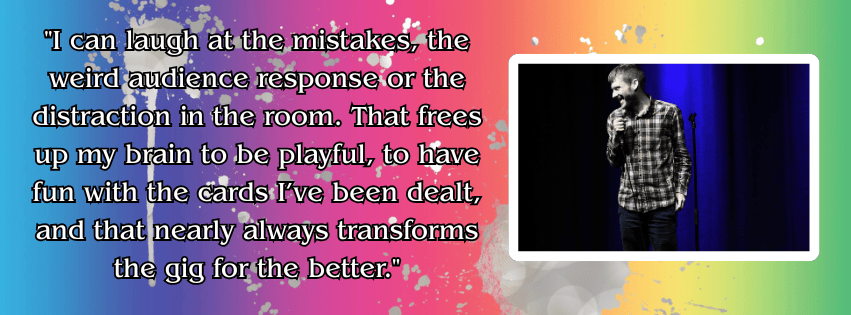
But on the occasions when I’ve felt a bit down about a gig, then asked myself, “What would happen if I enjoyed this?” and got curious about finding out, the gig inevitably gets better. I can laugh at the mistakes, the weird audience response or the distraction in the room. That frees up my brain to be playful, to have fun with the cards I’ve been dealt, and that nearly always transforms the gig for the better.
At the very least, I have a good time. The audience also tends to come with me because they can see that I’m having fun and that I’m confident. In fact, thank you for asking me the question, because it’s a timely reminder to myself to be better at adopting this mindset.
Just make sure, if a gig is going a bit weird and not as you’d hoped, to ask the question “What would happen if I enjoyed this?” internally. Don’t say it out loud, as that is more likely to further compound the weirdness.
David is headling Blizzard Comedy on Thursday 15th October. Book your free ticket here.
You can find out if he’s touring near you and keep up with his work by checking out his website and following him on YouTube, Facebook, Instagram, TikTok and Bluesky.

One thought on ““What would happen if I enjoyed this?” | David Eagle talks Visually Impaired Excellent, storytelling on BBC Radio 4 and finding the joy in every show”
Comments are closed.