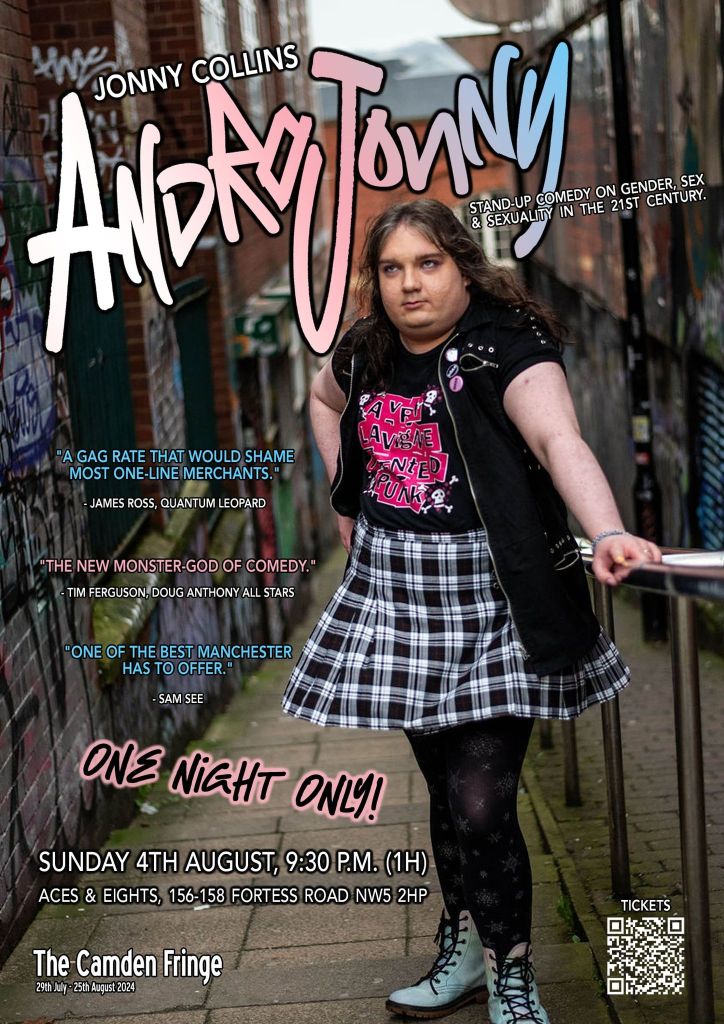
Tell us about your show, Andro-Jonny.
Andro-Jonny is the story of my self discovery and musings on identity, sexuality, socialised gender norms, and experiences existing as my authentic self in a world that is increasingly hostile to people like me.
That probably makes it sound deeper than it is. In essence, it’s a bunch of jokes about how sad I am that I don’t have tits and how happy I was to discover there was a non-surgical way I could obtain tits.
What inspired you to write a show exploring such a personal journey?
Andro-Jonny is in many ways a culmination of my writing up until this point – like many people’s debut shows are. However, given I got into stand-up dead young, I am in a unique position where I do have a stand-up chronicle of my own identity progression since about 2012. So I think my debut show was inevitably going to be about this purely because it’s what my material has been about for the best part of my career.
I think in my personal life I tend to be something of an over sharer (as anyone who has me on any social media platform will attest to) and that absolutely translates to my stand-up. I look back at my material at least as far back as 2015 and there’s a lot of figuring out who I am throughout. Some bits I’ve grown past personally. Even if I still find them funny, they just aren’t true to who I am anymore and have been retired, but a few bits still have some relevance I think.
So the boring answer really is that the subject I talk about the most is me. And that just happens to be adjacent to the ever more important topic of gender and sex and the social context of those things in the modern day, as that’s my experience interacting with life.
What is your technique for bringing out the funny side of the series topics your show explores?
Questions like this really expose my imposter syndrome as honestly I don’t really feel like I have a technique. I just tend to say what I think is funny about whatever i’m musing on and if others agree I keep it in. I guess a thing I am mindful of is to always balance the narrative importance of what I’m saying versus the comedic value. Going too far one way, it stops being a stand-up show, and too far the other way risks undermining the core point. But as to how I specifically go about doing that, the jury’s out. Come back to me on my show retrospective in 5-7 years time and I’ll maybe have a better answer.
What I will say, particularly on topics of gender and sex, as a comedian I feel like I have an earnestness and authenticity about what I’m talking about. Even the moments where the specifics of the story are tweaked to be more comedically efficient are rooted in my experience. I think audiences can tell that.
There’s a lot to be said about that translating better into humour. When I try and write about things I don’t understand, that rarely seems to work. Even if the bit is technically accurate and well written, the fact that I am speaking from an inexperienced point of view hinders the realism of my performance.
I’m sure if I take a metaphorical scalpel to the show, I’ll be able to dissect and analyse the behind the scenes mechanics of what exactly makes the funny side of serious topics come out. But from a creative writing point of view, I generally just look for the funniest angles.
When talking about transphobia in particular there’s a lot to be said about that bigotry having very nonsense roots and motivations. There is humour in the obsessiveness over strangers’ genitalia. Pointing out that ridiculousness isn’t going to change a transphobe’s mind. But laughing at the weirdos who want to legislate spaces away from people based on the shape of the hole they piss out of delegitimizes their “concerns”. Hopefully, it will ground people on the cusp of radicalization before they fall too deep into that rabbit hole.
I have deviated so far from the question, I’m a terrible interviewee. I’m so sorry. (Editor’s note: Don’t be sorry, I love you xoxo)
How do the political and philosophical themes of this show relate to your own experiences?
I experience social politics and the observable reality through the lens of my own identity, as we all do. There isn’t really a way that these things don’t intersect. Even when I’m talking about more mundane topics and seemingly irrelevant ideas, that context is always there.
The fact is that having this journey of personal self-discovery occurs alongside an external political context and perception. So my own identity is never free from that scrutiny. It is low key horrifying that you have to become something of an expert in sociology and aspects of human biology in order to justify your own existence as trans people to be good enough to be accepted. And that still isn’t enough for many.
I dream of a day where a trans person can just wake up and be like “I have no connection to my assigned gender, so I’m not that” and that’ll be the end of it. And maybe I’m naively optimistic, but I think that is achievable, potentially within my lifetime. I’m already seeing it in Gen-Z queers having so little time for the hangups of previous generations, and more and more people who present as their assigned gender still being like “Yeah this aesthetic is my vibe, but I have no attachment to my gender, it’s weird we’re still categorized like this, I don’t wanna be a part of this club, just let me exist.” It’s inspiring, honestly.
I’ve said that I want my show to help people become exposed to terminology and outlooks on gender that might resonate with them. But honestly I may learn more from my audiences than I could ever dream of teaching them, and that’s cool too. I’ve written a funny monologue about gender and sex, but in the context of the room it’s a shared experience. I’m not a lecturer, and I am very open to absorbing and learning from how the experiences of others differ to mine, and the crossovers as well. It gives a real community feeling that is invaluable in queer spaces that is my favourite thing about performing in them.
YouTube video essayists have deconstructed the history of gender as a construct and the nuances of sex far more intricately and in some cases probably wittier than I will ever do. My show isn’t going to break new research or educational boundaries, but it will I hope connect people through these shared experiences.
How does this show build on the reputation you’ve established as a pioneer of queer space in contemporary comedy?
Is that a reputation I have? I’m flattered. I just think i’m a bit of an obnoxious gobshite. Blizzard was never really driven by a desire to be an overtly queer space, I think that was just incidental by both the comedy that I find funniest and the political ethos and motivations behind the space. I think if you’re going out of your way to try and make an inclusive, accessible and safe space for comedy, you will naturally find the queers both in audiences and performers who will flock to it, largely as a result of how a lot of us are still under-represented and unsafe in more mainstream club gigs. (No shade to the people who run them, we’re just also often the brokest people around so from a strictly business standpoint I get why you don’t cater to us specifically!)
I think, as I alluded to above, my development as a comedian was parallel with my development as a person. While I did know I wasn’t straight before I came out as a comedian, gender stuff was something that remained buried and unrecognized for longer for me. In that sense I don’t know if this show is necessarily building on that. Moreover it is the next logical step in my comedic development.
I’ve definitely lent more into the queer side of my comedy over the last 7-8 years, as I’ve been more comfortable and confident in myself. I think about trying to write an hour of comedy about literally anything else and I wouldn’t even know where to start.
So yeah, this show is a symptom of who I am, not a building block I guess, and I apologize profusely to everyone who has kept up with me over that time and is still putting up with it. I appreciate you all so much.
How have the previews of the show you’ve already done been received so far?
The first one amazingly! I think it helped that I was doing it at home at Blizzard, although that was a bit of a double edged sword as they were already familiar with a lot of the core segments of the show in different contexts, So the percentage of actual new content was fairly slim. Really just the very beginning, the end, and a couple of new ideas in the middle that didn’t go anywhere near as well padding out my own coming out story.
But the feedback I got was that it was really interesting and positive to see all these little bits that have been staples of my set from anywhere to a few months to several years actually shaped together to tell my own story. I think a lot of people who knew me through comedy already did ‘get’ me more afterwards, and I think that’s a good sign for a debut hour. Really it is your introduction to the wider industry for a lot of people. I think it worked well in that regard.
The only other preview I did was a heavily condensed version at the Nottingham Comedy festival last year, and that didn’t go anywhere nearly as well. I got off to a bad start and I think I struggled to condense the narrative into half an hour. I ended up speeding through it and missing both the narrative beats and joke rhythm, so it was a bit of a mess.
But I think I learned from it. It was my first time for a while performing a long set to a room of people who mostly didn’t already know who I was. The challenge to perform this show in a way that didn’t rely on people having a base familiarity with me was interesting and something I’m looking forward to in London – which I am hoping will be a mixture of people who know me but don’t see me every month and hopefully some new people from local queer communities.
This show will really be the first test of the full hour outside of my home context, and I am equal parts terrified and excited about it.
What are your hopes for the show going forward?
For ages my goal was to do Edinburgh by 2022. 10 years into my stand-up career. Spoilers; that didn’t happen. So I reflected and thought about it, and actually realised that I didn’t really care about doing Edinburgh as such. I just wanted to have an hour, and I’d spent the last few years building myself a platform where I could do it. So my goal changed to just write and perform this show once, and then I’ve done it.
I didn’t really think long term after that, but opportunities to do the show came up again. London will always hold a special place in my heart as the place I grew up and started performing, so really Camden is the festival for this show.
Moving forward, I’d like to keep honing it around the country. Generally this last year has been me dipping my toes back into performing outside of Blizzard on a more regular basis. I’d love to build up a national cult audience and eventually do a little tour of this show around independent arts festivals and queer clubs around the country, and eventually get a recorded version I can post online. At that point I think I’ve hit basically all my comedy milestones.
I learned fairly early on that I thrive with comedy better when I keep my goals achievable and focus on enjoying the art. So I try to be easy on myself. Once i’m happy with where I am, I’ll think about what to do next, but I don’t really think super long term. I’m still just thrilled that I have my own show to be honest.
I look back at 16 year old me tentatively turning up to open mics underage and hoping no one would ask me for ID so I could do 5 minutes of new jokes I’d tried to write, and think how fucking proud I would be of myself for just doing an hour of material and having an audience to do that to. That’s such a nice grounding feeling.
So yeah, small steps. Camden is the big one for me, if it goes well maybe I’ll think about doing more. Maybe I’ll just book a venue and record it and share for free online to be found in half a decade’s time by another young hobbyist to obsess over and inspire to pursue stand-up, much in the way Andrew O’Neill’s Occult Comedian was for me when I first saw it in 2012 on YouTube. That would be a mark of success for me I think, I really don’t need a lot.
What do you hope people take away from your show?
Beginning my own transitional journey has really highlighted just how forcibly rigid our societal perception of gender and sex is, and how that just doesn’t add up with the reality of observed biology despite that being a dogwhistle the transphobic people will use to delegitimize our identities. When you take a step back and actually view from a bigger picture just how obsessed we are with the rules of gender and presentation and how hostile we are to people who deviate from those rules, it is objectively very funny.
But it’s also scary, and I want this show to be a respite of comradery for other young trans and gender non conforming people, and perhaps an education for allies genuinely willing to learn.
I don’t think I’m going to solve transphobia or anything like that. But my comedy isn’t for them, it’s for us, to discover that actually you’re not the only person who feels this way, and you aren’t alone in the world even when it feels like you are, and to share in that trans joy and whimsical silliness together for that fleeting moment. It’s the kind of comedy show I’d’ve loved to see, and I hope I can create that for others who will be just as excited and moved by it.
Do you have any advice for anyone hoping to get into comedy?
Don’t, it’s a terrible industry and will consume your whole soul.
Genuinely though – my advice is less practical and more personal. But I’d say the old cliche of don’t measure yourself against other people. Figure out what you want out of comedy and focus on that.
Don’t let anyone tell you what the right or wrong way to do it is. Whether you’re gigging twice a night, grinding away at the circuit until you break through to the professional level, or if you just do an open mic every other month to voice new ideas you’ve spent the last few weeks coming up with. Both are equally valid and important parts of the circuit. Identifying what you want out of the art is far more important than trying to match up with what your contemporaries are doing.
I enjoy comedy so much more on my own terms than I ever did trying to follow the path that I thought you were meant to take for career success. I’ve been lucky enough to get recognition and opportunities out of it that I’m grateful for. But even before I hit those milestones, I was doing so much better for performing on my own terms.
So I’d say find clubs that you enjoy watching as well as performing at. Pretty much no gong show or competition is going to rocket you from open mic-er to superstar. Yes some can be very handy shortcuts, but they are also soul destroying if you don’t actually want to do them and you just want the rewards that come from doing well in them.
Go to local comedy clubs – find your local Blizzard equivalent – Quantum Leopard in London, Diversity Quota in Glasgow, etc,. Go along, as a punter. The promoters are normally very happy to chat with you if you’re interested in performing. They might not give you a spot straight away, but they will give you guidance on applying and where else to look to get experience and videos and references and so on. Most importantlym we wouldn’t recommend places that we wouldn’t go to ourselves, so you can hopefully dodge places that you wouldn’t vibe with, without having to find out the hard way.
Comedy is meant to be fun. If you’re not finding it fun doing and being around comedy, it is not worth your mental health to do it, honestly.
Jonny is performing Andro-Jonny at Camden Fringe on Sunday 4th August.
You can keep up with Jonny and their work by following them on Facebook, Twitter and Instagram.