

Tell us about the show you’re bringing to Brighton Fringe Festival, A Night With Ross Feratu & Friends.
A Night With Ross Feratu & Friends is a fun-filled hour of merriment, music, and madness! Hosted by Ross Feratu, in his own inimitable style, there will be plenty of jokes, lots of laughs, tons of silliness and some VERY special guests! Some of those guests include ‘Nathaniel’ (who’s NOT a poet and doesn’t know it), goofy Ornithologist, ‘Dawn Chorus’ and multi-award-winning, hapless 1920’s movie star, ‘Silent Lee’.
There are elements of Music Hall and Vaudeville theatre in there, as well as the old variety shows of the 90’s, starring legends like Russ Abbott and Bruce Forsyth.
What inspired you to perform stand up as Ross Feratu? Where did the idea for the character come from?
I’ve been writing and performing comedy for a while, but I started to become tired of my own voice (my wife will confirm this) so I started experimenting with characters and that’s where I came across ‘Ross Feratu’.
I thought he was unique – a lonely, reclusive, cockney vampire (although that’s never referred to) who fills his days people-watching and relentlessly passing comment on the mundanity of life. It’s Victor Meldrew meets Quasimodo.
I started making short video diaries of Ross, as well as calling in to The Jon Holmes Show on Talk Radio and BBC Radio, every Saturday lunchtime, where Ross would phone in to purposely disagree with other callers on various topics, leading to some very funny exchanges. Ross grew a bit of a cult following from that and now I can’t stop performing him.
I love taking Ross out. He couldn’t be further away from me as a person, and I absolutely disappear when the mask is on.

What is your creative process like for coming up with comedy characters?
I like to create unique and distinctive characters to perform. Most ideas in comedy have already been done at one stage or another so coming up with something new and refreshing can be challenging.
For Ross, I spent hours in the mirror, or walking around the house talking to myself, as well as filming and watching back short video clips, trying to ‘find him’ as it were. It was an exciting process – discovering what voice suited him, his mannerisms, his opinions, what type of personality he had, his strengths, his flaws, etc.
A character comedian is a bit like Dr Frankenstein. They use parts from the people around them or people they’ve met, to create monsters. I love basing my characters on people I know.
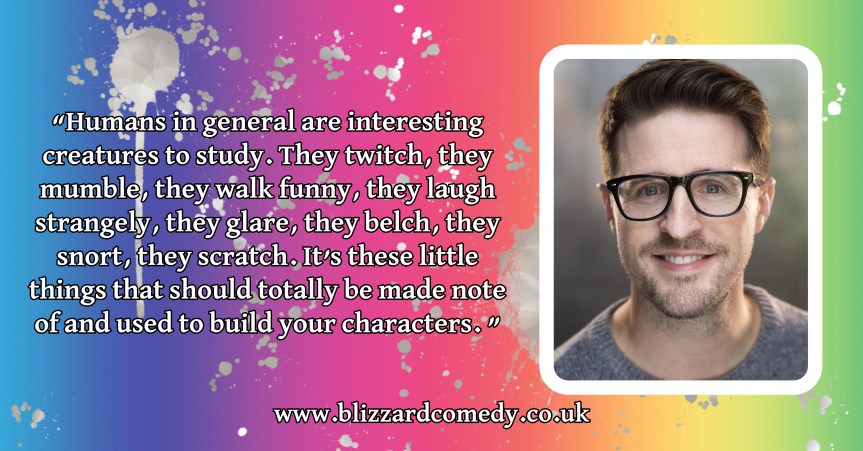
Obviously, I don’t know anyone who walks around talking to themselves in a vampire mask (except for myself), but the way the people around me do and say different things fascinates me. Humans in general are interesting creatures to study. They twitch, they mumble, they walk funny, they laugh strangely, they glare, they belch, they snort, they scratch. It’s these little things that should totally be made note of and used to build your characters.
What I also find interesting is that, no matter how much you think you know the character, they always surprise you when performing as them. ‘Ross Feratu’ was originally called ‘Kampire’ (a camp vampire) an ironic title – seeing as he was meant to be a bit of a brute – full of toxic masculinity and aggression. His voice was different, as were his mannerisms.
You know when you’re out in a pub or club and a drunk bloke comes up to you (fellow nerds will relate to this), square up to you, try to intimidate you and then laugh and say “I’m only jokin’ mate! You should see your face!” That’s who Ross was originally based on. Those idiots. However, he has since changed.
Now he’s a bumbling, forgetful, loveable buffoon who prefers his own company and who is just trying to get through the day. Which is why it’ll be interesting putting a bowtie on him and sticking him in front of an audience in Brighton.
At what point does a fun idea start to feel like a fully fleshed-out character for you?
When there are no doubts in my mind about my character’s character. When I know exactly who they are and what they would do and say in any given situation. That’s when I feel they’re fully fleshed out. For example, if I asked Ross what his favourite movie was, he would name a Jason Statham movie for sure. Most probably Crank 2. If he was offered a drink, he wouldn’t want one but would settle for a Babycham if the buyer insisted. I know how he votes, what he eats, his previous operations, how he sleeps, everything.
Performing characters to an audience also really helps. I can have a fun idea and I can write it down on paper but until I’ve performed it to an audience, to actual critics, I don’t know how well it’s going to go, or indeed if it’s going to be funny or not. The things that make me laugh, won’t necessarily make an audience laugh.
I am also probably the only person who does this, but I like to design a fictional poster for my character quite early on, as if I’m ready to do a live show with them. It makes the characters seem more real to me, rather than just an idea in my head. Imagining how their show poster would look, also helps me decide how the character would look. I am strange, I realise this.

What do you think is the secret to great character comedy?
To make your character familiar to people – someone we can all relate to in some way. Either through ourselves or through someone we know.
You need to know your character so well it scares you. You should know your character’s triggers and their weak spots, as well as their goals and their comforts. And they should be flawed in some way, a flaw that doesn’t go away, despite their attempts to try and make it.
You should be able to put your character in all sorts of different scenarios and locations and know how they’d react or how they’d cope there – or indeed if they wouldn’t cope at all! Like in any great sitcom, the leading character should always be a fish out of water. Just like Hyacinth Bucket, Alan Partridge, or David Brent – you should be able to take your creation anywhere and because of their strong personalities, their flaws and their inability to change, we will witness them become a victim of their own demise (whilst making us laugh in the process).
As Jerry Lewis put it, “Comedy is a man in trouble. And without it, there is no humour!”
This show has been in the works since before lockdown. Has it changed much since you were last working on it? How?
It has changed a lot. I had only two characters before lockdown, Ross and one other. However, the effects of lockdown, and spending so much time at home, allowed me to take my time with the writing and to come up with several other very special characters, I possibly wouldn’t have come up with otherwise.
With one of them (‘Silent Lee’), I created 15 short films and went on to win 22 awards at comedy and film festivals all around the world. These films are something I’m very proud of and I will be showing some of these throughout the show.

What do you hope people take away from your show?
I just hope people have a really great time. I want folk to leave with a smile on their faces. There’s no mention of politics, climate change, Covid, or anything depressing like that in the show. Whilst those things are obviously important, hopefully people will come to see Ross and his friends and escape from that stuff for a good 60 minutes.
Are there any other shows you’re looking forward to at the festival?
There are loads actually! It’s a great year for comedy and I urge people to get out and see as much as they can.
There are lots of great free shows at the festival too which is fab to see! I’m very much looking forward to Chris Willoughby’s ‘Testicle’ (!) at The Lantern Theatre, as well as Stefania Licari’s show ‘Medico’ at the Laughing Horse @Caroline Of Brunswick. Two ridiculously funny comedians who I believe are going to be huge – so go see them now before they hit the big time!
Do you have any advice for anyone looking to get into comedy?
Please do it. We all need it. Make a note of EVERYTHING you find funny. Then try and dissect it and find out WHY you think it’s funny. Write down things you’ve said or done that made your friends and family laugh. Basically, make a note of everything. There is comedy EVERYWHERE and you can’t trust your brain to remember any of it so always make notes. Before long, you (or your character) will have a rough five-minute set that’s ready to test out on the general public.
Find that inner child and start to play around with voices, masks, costumes, wigs… just experiment. Sign up to an improv course (invaluable, trust me) or a clowning course! Have a play at imitating all the different accents and voices from around the world and see which ones are your strongest (or indeed your weakest). Mimic stars and people off the TV. Watch your heroes – and the people who made you laugh growing up. Copy them (not their material) but follow their careers, look at their process and how they got to be where they are – then do the same.
Watch as much comedy as you can. Watch silent comedians like Buster Keaton, Harold Lloyd, Rowan Atkinson and Jacques Tati. Listen to Victoria Wood, Billy Connolly and Ken Dodd. Watch stand-ups like Lee Evans, Richard Pryor, Steve Martin, George Carlin, Fatiha El Ghorri, Kathryn Ryan and Simon Amstell. Watch character comedians such as The League Of Gentlemen chaps, Rik Mayall, Steve Coogan, Morgana Robinson, Julia Davis, Caroline Aherne and Catherine Tate. Watch as much material as you can, from all areas of the comedy spectrum, to find your influences.
Being a comedian can appear to be the most terrifying job in the world, and it can be quite intimidating at times, but only before you perform. Not during. Being on stage is the best feeling in the world. That moment when you get your very first laugh for something YOU’VE written, from an idea YOU’VE had – makes it all worthwhile. There’s no greater feeling.
So get a notepad, grab a wig and go make a monster! (But come see my show first.)
A Night With Ross Feratu & Friends will take over The Caxton Arms for 5 days during Brighton Fringe (6th/18th/20th/26th May and 3rd June). Ages 12+. Warning: the show may contain scenes of Jason Statham.
You can find out more about Lee and his work by checking out his website and following him on Facebook, Twitter, Instagram and YouTube.
