

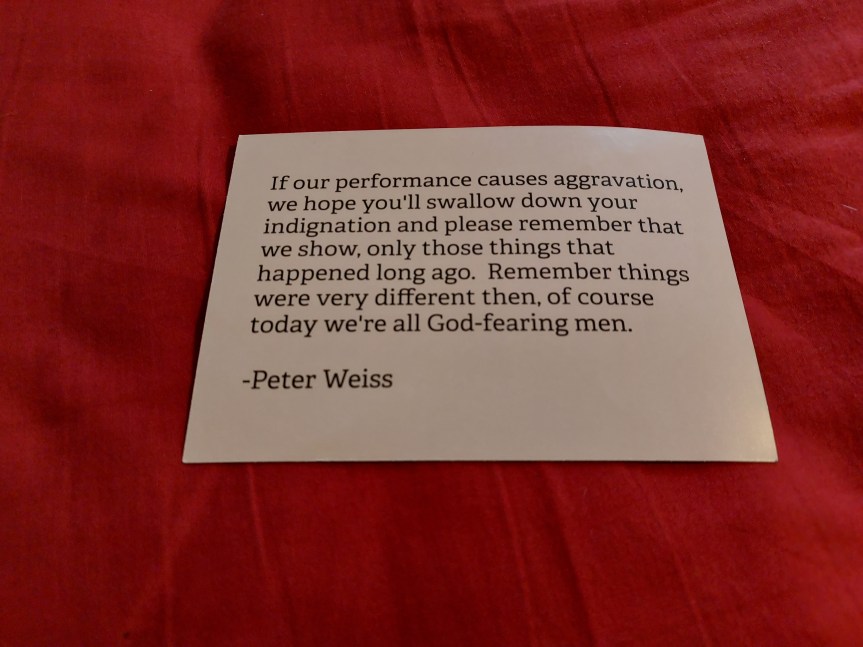
When you arrive at The Ballerina, you are greeted by a mysterious figure wearing an animal mask. They hand you a card containing advice on how to process the show, a tongue-in-cheek line that reassures you in a way that isn’t entirely believable.
The actors are already in position as you take your seat. Two people with burlap bags over their faces stand still and stiff in uncomfortable positions, while three masked figures watch over them, dancing. There is an immediately ominous atmosphere. If you hadn’t read the description of the play before you booked your ticket, you nonetheless get a very clear impression of what awaits before the show even begins.
The Ballerina begins as a conversation between an imprisoned British diplomat and her interrogator, Pacifique Muamba. The power imbalance is immediately apparent – the tall, muscular man with a gun towers over the small imprisoned woman. But it also stands in stark contrast to the power imbalance in the countries they represent: a nation torn apart by a number of wars within living memory in perpetual turmoil thanks largely to the historical and current meddling of the west.
The conversation centres around a cultural outreach initiative designed to engage the country’s young people in politics. In the words of the diplomat involved, to teach them about their civic responsibilities in a democratic state. But it expands to cover much broader territory
It challenges the west’s understanding of democracy. It highlights the hypocrisy of British and US politics that claim to be democratic while offering their own peoples extremely limited options that, from afar, don’t look all that dissimilar and don’t do much to prioritise the common man. It uses specific examples to even illustrate how countries with democracies most efficiently designed to offer as much control as possible to the population still get caught up in extremism.
While the imprisonment and the violence directed solely at one representative remains abhorrent, it’s difficult to ignore validity in the interrogator’s points. Even when the west isn’t posting soldiers around the world, they still interfere. It’s still ignorant of Britain to host cultural projects in foreign countries designed to encourage people to adopt their style of politics while that exact system is so horrifically broken in their own country.
The Ballerina doesn’t necessarily doesn’t get hugely specific here. But there are enough news stories of resentment against the British government at the moment that come to mind with minimal prompting. Voter ID is coming into effect in a flagrant attempt to suppress marginalised voters who can’t afford photographic ID even though there are practically zero cases of voter fraud. Young people aren’t engaged with politics because they don’t see a fulfilling future ahead of them offered by any political party. Nurses, teachers, firefighters, almost every essential worker is striking because they’re struggling to survive.
If this play had been staged at any point in the past decade – probably longer – it could have had just as many international embarrassments in the news to put the cherry on the cake of its point.
What right does Britain have to tell any other country how to manage its political system?
The argument on behalf of the British is put into the mouth of someone who is clearly intelligent, competent and passionate. She cares about making a positive impact on the world and she does that through art and culture, peaceful initiatives that provide people with a platform. Her noble and philanthropic ambitions come from a good place. She – personally, individually – has no intention of harming anyone.
But as the conversation progresses, it becomes clear that she is naive. She has swallowed a lot of the propaganda her government has fed her. She is ignorant of the darker underbelly of British foreign affairs, possibly because she choose not to look for it. She doesn’t realise that she is a pawn, that she is the sweet, virtuous face behind which her government hides its crimes.
The Ballerina escalates out of the conversation. It is a graphic show that culminates in very convincing torture simulations. But it makes its point. It ultimately shows how little governments truly care about their people, how willing they are to let human beings be collateral damage in their pursuit of their own goals.
The Ballerina is a show that stays with you. It doesn’t offer answers because, frankly, there just aren’t the kind of easy answers that can be explained and presented in the space of a show that lasts 75 minutes. But it gives you a lot to think about. It offers a new context in which to understand the world around you, a new perspective to consider next time a western government announces a cultural outreach programme in a country that is none of their business.
Read our interview about The Ballerina with creator James Barnes here.
Find out more about the theatre group behind the show, Khaos, by checking out their website and following them on Facebook, Twitter and Instagram.
