

Tell us about your show, The Ballerina.
I like to think of it as Joseph Conrad’s ‘Heart of Darkness’ meets Roald Dahl’s ‘Charlie and the Chocolate Factory’. Audiences can expect a visceral experience, one that starts as soon as they enter The Cavern and endures right up until the very last moment. Not to give anything away but Anne-Sophie Marie has created something unique and unpredictable. If our 2019 production in New York City is any indication, there’ll be something for everyone. A real genre defying piece of work that places Africa’s democracy at the centre of the discussion.
What inspired you to create this show exploring democracy as a concept?
I came to the play as an actor in 2015 when it was a 10-minute piece written as part of Theatre 503’s Rapid Write Response. Over the years, as Anne-Sophie developed it with me in the role of Pacifique, it became clear to me that democracy had become a dirty word and was holding us all back from calling things what they really were.
What are the key fallacies you want to deconstruct through The Ballerina?
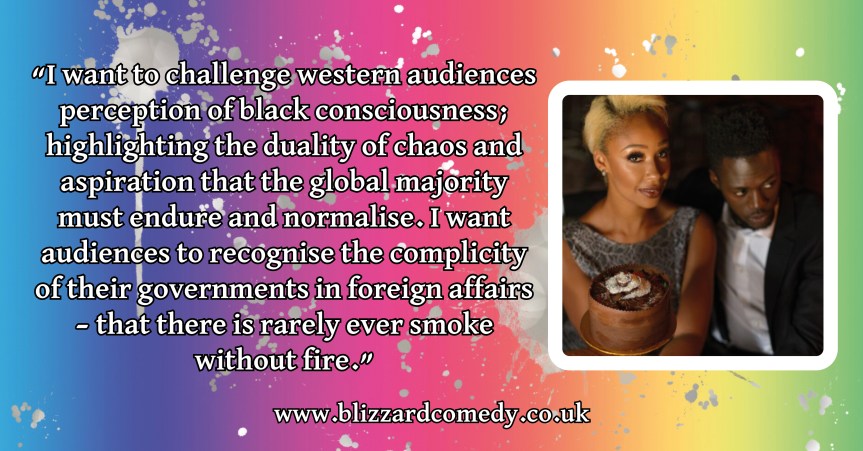
Good question. At the heart of this play, I want to challenge western audiences perception of black consciousness; highlighting the duality of chaos and aspiration that the global majority must endure and normalise.
And fundamentally I want audiences to recognise the complicity of their governments in foreign affairs – that there is rarely ever smoke without fire.
What is your trick to exploring such enormous concepts in the space of a single show?
Compulsion helps. I feel compelled to tell this story and in a way, it’s a form of protest so that gets the heavy lifting out of the way so to speak. It makes it human, visceral. Beyond that, I’ve got a great script by way of Anne-Sophie Marie; a script that allows me to have pertinent conversations and ask the hard questions.
What is the significance of setting The Ballerina in Africa?
I can’t say much about the origins of the story but it is partly based on truth. It becomes significant the more we think about Africa’s history and its future. Some are still very ignorant as to why the world’s current power balance exists, and The Ballerina touches on that. As a narrative showcasing a black character of Shakespearean proportions, it’s important to create worlds that people can identify with beyond that of our western capital cities.
How much of the show is drawn from real world events and how much is imagined?
That’s classified.
How has the process of creating this show impacted your view of the world?
It’s made me sharper and more resilient to the nature of politics and people. Ultimately, people don’t want to think anymore – is something Pacifique says and I’d have to agree with him. If you want to question and or solve a big problem, you have to be willing to face it head on, and every now and again, entertain venturing down the rabbit hole.
What do you hope people will take away from The Ballerina?
A language of violence. The Ballerina opens a conversation about the darker angles of our nature and what happens when all of that is left unchecked. I’d really love it if audiences leave questioning how they view Geopolitics and the institutions that are supposed to make this world a fairer place.
What are your hopes for the show after your Vault Festival run?
The Ballerina is a flagship show for Khaos, even without the pandemic, we invested a lot of time into it. The version here still isn’t the full length piece and it’d be great to have it on elsewhere for a proper run. Long term, we want this play to have its time in the spotlight and we’ll take that in whatever form it comes.
Are there any other shows at Vault Festival that you’re looking forward to?
My Period the Cockblock, High Steaks and An Ice Thing to Say.
Do you have any advice for anyone looking to get into theatre?
Two things. Either get rich first or make sure you bloody believe in what you’re doing.
The Ballerina is running at Vault Festival from Tuesday 31st January to Sunday 5th February.

One thought on ““I feel compelled to tell this story and in a way, it’s a form of protest” | James Barnes on how The Ballerina uses theatre to challenge democracy, complicity and power”
Comments are closed.